Makina Market -
Caveni.Arlington@gmail.com
+254 769 944116
The best fabric for custom office suits in Kenya depends on the work environment, the altitude of the deployment city, and the level of daily wear the garment will endure. Caveni Staff Uniforms guides every institutional client through a structured fabric selection process, matching material specifications to real operating conditions rather than applying a generic catalogue choice.
Kenya’s key business cities occupy different climate profiles. Nairobi, at 1,700 metres above sea level, experiences cool mornings and moderate afternoons, making medium-weight fabrics the practical standard. Mombasa’s coastal humidity calls for lighter, more breathable constructions. Kisumu and Eldoret sit in their own temperature and humidity bands, each influencing how a fabric performs during a full working day.
Caveni advises on fabric weight in grams per square metre for each deployment context, so staff are not wearing heavy wool twill in coastal heat or thin tropical weaves in Nairobi’s cooler months.
Wool-polyester blends in the 200gsm to 250gsm range are the most consistently recommended fabric for Nairobi-based corporate suit programmes. They hold their shape across a working day, resist creasing under desk wear, and maintain colour depth after repeated laundering. The polyester component adds recovery and reduces cost relative to pure wool.
For senior management and client-presentation roles, pure wool in 220gsm to 260gsm provides a premium drape and breathability that polyester blends cannot fully replicate. For high-rotation front-line staff, polyester-viscose blends offer a more budget-efficient option with adequate durability.
| Fabric Type | Weight Range | Best Use Case | Kenya Climate Suitability |
| Wool-polyester blend | 200-250gsm | General corporate wear | Nairobi year-round |
| Pure wool | 220-260gsm | Senior management | Nairobi, cooler months |
| Polyester-viscose | 180-210gsm | High-rotation front-line | All regions, warm months |
| Tropical wool | 160-190gsm | Coastal corporate | Mombasa, Kisumu |
| Cotton-polyester | 170-200gsm | Hospitality corporate | All regions, warm settings |
| Linen blend | 150-180gsm | Creative or casual corporate | Coastal and warm cities |
Fabric weight alone is not sufficient. Colour retention under Kenya’s combination of sunlight exposure and frequent laundering is a performance criterion. Caveni selects fabrics with proven dye stability, and uses Pantone, HEX, and RAL matching at the production stage to ensure the initial colour is reproduced accurately and consistently across an entire batch.
Jacket lining fabric affects comfort as much as the outer shell. Full polyester lining is standard for most corporate applications. Bemberg rayon lining, sometimes called cupro, offers superior breathability for warmer environments and is selected for client-facing staff in Mombasa and other coastal deployments. Caveni confirms lining specification during the client consultation.
What is the most durable fabric for daily office suits in Nairobi? Wool-polyester blends in 220gsm to 240gsm are the most balanced choice for durability and comfort in Nairobi’s climate.
Can Caveni source specific fabric weights on request? Yes. Caveni works with clients to source fabrics meeting specific weight, composition, and colour specifications.
Does fabric choice affect production lead time? Some specialty fabrics require advance sourcing and may extend the standard 10 to 14 working day lead time. Caveni confirms this at consultation.
Discuss fabric selection for your next uniform order with the Caveni team at +254 769 944116 or info@staffuniformsupplier.co.ke.
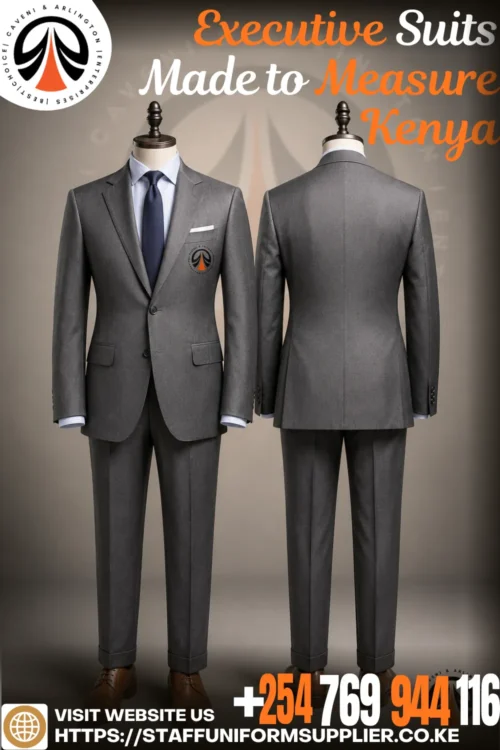
Executive suits made to measure Kenya, Caveni Staff Uniforms produces…
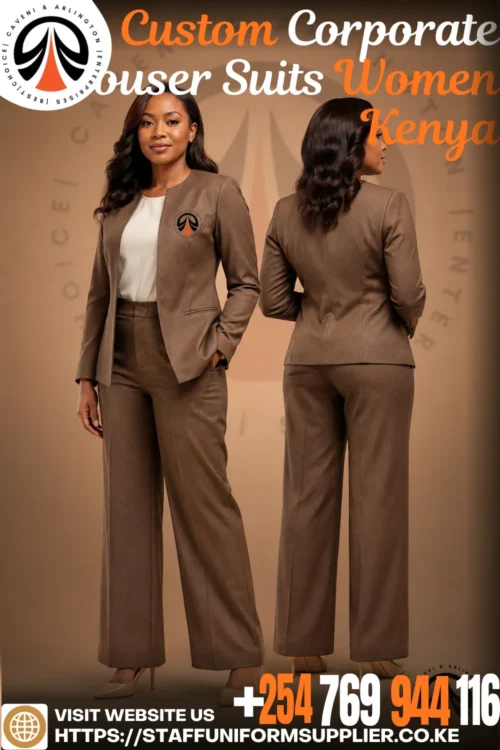
Custom corporate trouser suits women Kenya, Caveni Staff Uniforms produces…
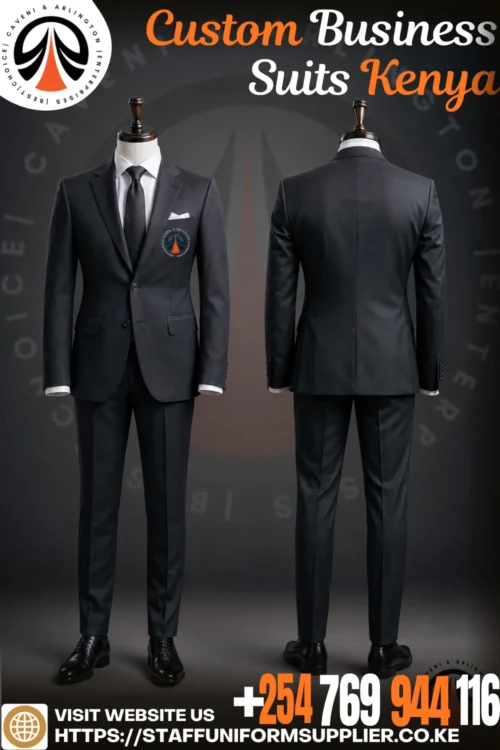
Custom business suits Kenya, Caveni Staff Uniforms designs and produces…
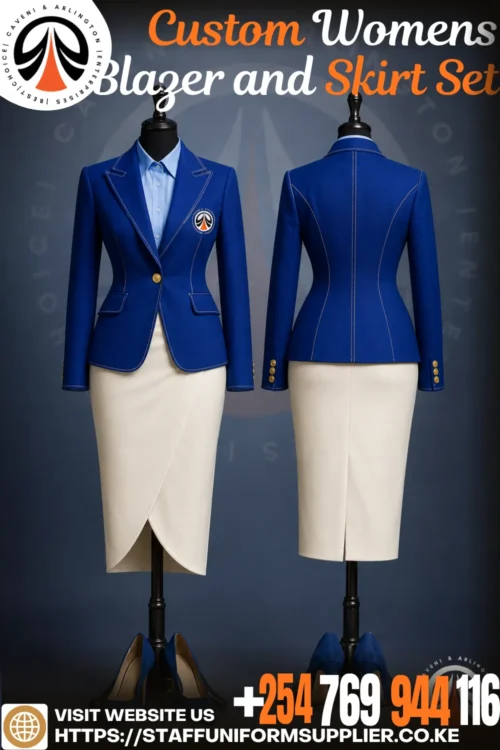
Custom womens blazer and skirt set Kenya, Caveni Staff Uniforms…